- Software
- DCAMCUT
- CAM Modules
- Multiaxis Module III
Multi Axis Module III
simultaneous
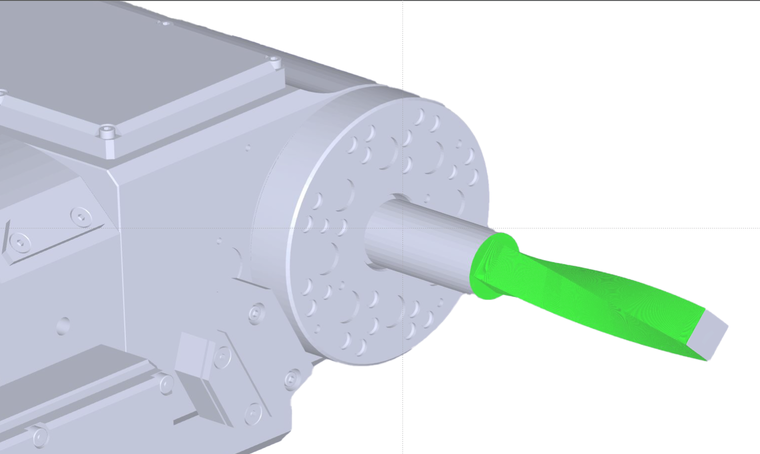
This multi-axis module offers the possibility of capturing component geometries that cannot be eroded without additional axes. Even the largest conics can be cut without any loss of surface quality or accuracy.
 Multi-axis module III simultaneous
The application corresponds to 4-axis programming. The fact that Z alignment is not taken into account in taper detection and the selection of the appropriate axis makes it simultaneous multi-axis machining.
DCAMCUT generally starts with contour definition. Programming is complete once the starting point has been set to the desired position and the template technology has been applied.
DCAMCUT programming generally begins with contour definition. Once the starting point has been set to the desired position and the DCAMCUT “template technology” feature has been applied, programming is complete.
[Template technology enables you and your colleagues to store all machining processes in cataloged form and reuse them at any time, even across models. This significantly minimizes manual error rates.]
After defining the raw part and selecting the additional axis, DCAMCUT displays the machining process in the solid simulation.